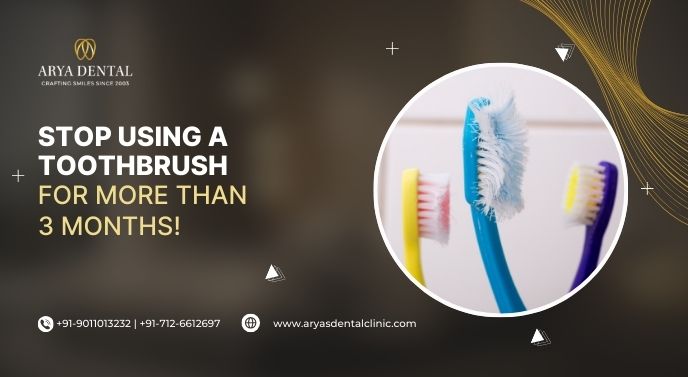
We regularly see patients invest thousands in whitening treatments, cosmetic procedures, aligners, veneers, and then resist replacing a toothbrush every three months.
We cannot help but admire the optimism.
At Arya’s Dental Clinic, Nagpur, we have genuinely lost count of how many times this conversation has happened.
We ask, “How old is your toothbrush?”
The response is rarely immediate. There is a pause. A thoughtful stare. A calculation involving festivals, weddings, maybe even lockdown timelines.
And then comes the confident estimate.
“Six months.” Sometimes a year. Occasionally… longer.
Let us think about that for a moment.
We wouldn’t keep using the same unwashed towel for months. We wouldn’t scrub dishes with a sponge that has clearly given up. We wouldn’t drink from a bottle that’s never cleaned.
Yet somehow, the toothbrush gets lifelong job security. And that is where logic quietly leaves the room.
Why Should a Toothbrush Be Replaced Every 3 Months?
The 3-month toothbrush replacement rule is not a marketing trick. It is a hygiene standard backed by dental research and global associations.
Over a period of 90 days:
- Bristles begin to bend and lose elasticity.
- Cleaning efficiency has reduced significantly.
- Plaque removal becomes less effective.
- Microbial contamination increases.
- The brush head accumulates wear invisible to the naked eye.
Toothbrush bristles are engineered to flex gently and reach into tight crevices, between teeth and along the gumline. Once they splay outward, they lose precision.
You may still be brushing for two minutes.
You may still be committed.
But if the bristles are compromised, your brushing technique is fighting a losing battle.
Oral hygiene maintenance depends not just on effort, but on tool effectiveness.
What Actually Happens to a Toothbrush After 90 Days?
1. Do the Bristles Lose Their Shape?
Yes. And shape matters.
Healthy bristles stand upright and slightly rounded at the tips. Over time, they:
- Flatten
- Fray
- Curl outward
- Become uneven
Once this happens, the brush can no longer effectively disrupt bacterial biofilm, also known as plaque.
Plaque is sticky, resilient, and highly structured. It does not politely leave because you “went over it twice.”
It needs mechanical disruption. Worn bristles cannot provide that.
2. Does Cleaning Efficiency Actually Drop?
Absolutely.
Studies have shown that worn toothbrushes remove significantly less plaque compared to new ones.
If your teeth feel slightly rough even after brushing, that is not imagination. That is ineffective plaque control.
Inefficient plaque removal leads to:
- Gingivitis
- Bleeding gums
- Bad breath
- Early enamel damage
- Increased cavity risk
And yet, we hesitate to replace a brush that costs less than a coffee.
Remarkable.
3. Do Toothbrushes Accumulate Bacteria?
Yes.
Even with rinsing, toothbrush bristles can harbor:
- Streptococcus mutans (associated with cavities)
- Porphyromonas gingivalis (linked to gum disease)
- Various environmental microbes
Bathrooms are humid environments. Moisture supports bacterial survival. Toothpaste residue and organic debris create additional support.
You rinse it.
But rinsing is not sterilization.
And keeping it beyond recommended replacement frequency increases microbial load.
Are Electric Toothbrushes Exempt From the 3-Month Rule?
Short answer: No.
Electric toothbrush handles may last for years. The detachable heads do not.
The bristles on powered brush heads:
- Wear down similarly
- May wear faster if brushing pressure is excessive
- Accumulate plaque and bacteria in the same way
If you use an electric toothbrush, replace the head every 3 months, or sooner if visibly worn.
Technology is not immunity.
Do Bamboo Toothbrushes Last Longer?
Bamboo toothbrushes are eco-friendly, biodegradable, and a great sustainable choice.
But they are not permanent.
They follow the same 3-month replacement rule as plastic brushes. The bristles wear down at the same rate, and bacterial buildup happens just as easily.
If you use a bamboo brush:
- Store it in a dry area
- Avoid sealing it in a wet container
- Watch for mold on the handle
- Remove nylon bristles before composting
Being environmentally conscious is excellent. Being microbiologically conscious is equally important.
When Should You Replace Your Toothbrush Even Earlier?
Sometimes, waiting three months is already too long.
You should replace your toothbrush immediately if:
- You’ve recovered from a cold, flu, or throat infection
- You wear braces or aligners
- You’re undergoing orthodontic treatment
- You smoke frequently
- You consume excessive tea or coffee
- You are immunocompromised
And children? They deserve special mention.
They chew. They experiment. They press too hard.
Their brushes rarely survive three months in ideal condition.
How Should You Properly Store a Toothbrush?
Proper storage keeps your toothbrush hygienic, but it does not extend its lifespan. Here are simple, practical tips:
- Rinse thoroughly after every use to remove toothpaste and debris.
- Store it upright in a holder instead of laying it flat.
- Allow it to air dry completely before the next use.
- Avoid closed caps or containers while wet, as trapped moisture encourages bacterial growth.
- Keep toothbrushes separate so bristles do not touch and cross-contaminate.
- Never share your toothbrush, no matter how close the relationship.
- Optional: Soak the bristles in antibacterial mouthwash occasionally for added hygiene.
Remember, good storage preserves cleanliness.
What Are the Real Risks of Continuing to Use an Old Toothbrush?
Brushing daily and believing “it’s still usable” may feel sufficient, but an old toothbrush quietly reduces the effectiveness of your entire oral hygiene routine.
When bristles wear out, they lose their ability to remove plaque properly. And plaque that is not removed does not disappear on its own.
Here is what can gradually happen:
- Plaque accumulates along the gumline.
- Gums become inflamed and begin to bleed.
- Persistent bad breath develops.
- Tartar forms, which cannot be removed by brushing alone.
- Gum recession may begin over time.
- The risk of cavities increases.
In more advanced cases, untreated gum inflammation can progress to periodontal disease. Chronic gum problems have even been associated with broader health concerns such as diabetes and heart disease.
Frequently Asked Questions
1. How often should a toothbrush really be replaced?
Every 3–4 months is ideal. Replace it sooner if the bristles are frayed, bent outward, discolored, or if you’ve recently recovered from an illness.
2. Can an old toothbrush cause cavities?
Not directly. Cavities are caused by plaque and bacteria. However, worn bristles fail to remove plaque effectively, which increases the risk of tooth decay over time.
3. Is disinfecting enough instead of replacing?
No. Soaking a toothbrush in mouthwash may reduce surface bacteria temporarily, but it cannot restore worn bristles or improve cleaning efficiency. Replacement remains necessary.
4. Do soft bristles wear out faster?
They can, especially if you brush with heavy pressure. Using gentle strokes helps preserve the bristles while protecting enamel and gums.
5. Should children replace toothbrushes more often?
Yes. Children often chew on their brushes and apply uneven pressure, causing faster wear. Their toothbrushes may need replacement even before the three-month mark.
Still Holding on to That Toothbrush?
If your toothbrush has survived more than one season, it may be time to let it retire gracefully.
Replace it. Start fresh. Give your oral hygiene the efficiency it deserves.
And if you are unsure whether your brushing routine is truly effective, visit Arya’s Dental Clinic, your trusted dental clinic in Nagpur, for a professional evaluation.
We would much rather meet you for a routine checkup than an avoidable emergency.