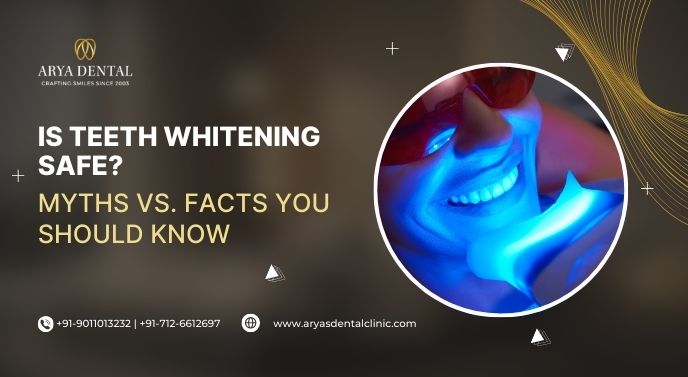
I have lost count of the number of times patients sit across from me in the chair and ask, "Doctor, is teeth whitening actually safe? I've heard it damages your teeth."
And honestly? I get it.
Between the aggressively marketed home kits at the pharmacy, the Instagram reels promising a Hollywood smile in 30 minutes, and that one friend who swears by rubbing lemon on their teeth, it's genuinely hard to know what to believe.
So let me do what I always do. Let me just talk to you honestly.
Why Do Teeth Stain At All?
Before we talk about whitening, let's understand why teeth lose their brightness in the first place.
Ask yourself, how many cups of chai do you have in a day? How about coffee? Do you eat turmeric-rich food regularly? (And if you're from Nagpur, I already know the answer to that one.) Do you smoke or use tobacco in any form?
All of these, over months and years, work their way into your enamel and the layer beneath it called dentine. Add ageing to the mix (enamel naturally thins over time, exposing the more yellowish dentine underneath), and you have a very natural, very common reason why teeth gradually lose their shine.
It's not a hygiene failure. It's biology. And the news is, it's treatable.
Is Teeth Whitening Safe?
Yes. When done correctly, under professional and correct supervision, teeth whitening is safe and effective.
But, and this is a big but, the word "correct" is doing a lot of heavy lifting in that sentence.
The Myths. And The Actual Facts.
Myth 1: "Whitening permanently damages your enamel."
This one I hear almost every week. And I understand why, it sounds logical. You're putting a chemical on your teeth. Surely it must be eating away at something?
The fact is, professional whitening, performed at appropriate concentrations with proper protocols, does not permanently damage enamel. The sensitivity some people feel is usually temporary, it resolves within a day or two after treatment.
The trouble comes with unsupervised, repeated use of strong agents, which is exactly what some aggressive home kits encourage. That's a different story.
Myth 2: "All whitening products are the same, a kit from the pharmacy is just as good as clinic treatment."
I genuinely wish I had a rupee for every time I've heard this.
They are not the same. Not even close.
The concentration of the bleaching agent, the quality of the application, the protection provided to your gums, and the monitoring throughout the process, all of this is night and day between a professional clinic treatment and a box you picked up at the medical store.
Advanced kits use weaker agents, often fit poorly (which means the gel touches your gums and causes irritation), and give inconsistent results. Some of them, particularly the ones making dramatic promises, compensate for weaker bleach by using abrasive ingredients that wear your enamel over time instead of actually bleaching it.
Myth 3: "Natural remedies - lemon juice, baking soda, activated charcoal, are safe because they're natural."
Ah. The "natural = safe" assumption. One of my favourites to address.
Lemon juice is acidic. Acid erodes enamel. Rubbing it on your teeth regularly is genuinely harmful, there is nothing protective about it being "natural."
Charcoal-based toothpastes? Studies have actually shown they reduce enamel microhardness and increase surface roughness. In plain language, they scratch and weaken the surface of your teeth.
Natural does not always mean safe.
Myth 4: "Once I whiten my teeth, the results are permanent."
I really wish this were true, it would make my job easier!
Unfortunately, whitening results are not permanent. How long they last depends entirely on your lifestyle, your chai and coffee consumption, whether you smoke, how well you maintain your oral hygiene, and whether you come in for periodic touch-ups.
Most people get a good 1–2 years from a professional whitening treatment with reasonable maintenance. Some more, some less. Setting realistic expectations before treatment is part of what we do at a proper consultation.
Myth 5: "If my teeth are white, they're healthy."
This one is actually a little dangerous, because it works both ways.
White teeth are not automatically healthy teeth. And yellow or stained teeth are not automatically unhealthy.
Whitening is a cosmetic procedure. It does not treat cavities, gum disease, or infections. I've seen patients who were focused on whitening when they actually had active decay that needed to be addressed first. Skipping the assessment and jumping straight to whitening in such cases can drive bleach into a cavity, reaching the nerve and causing significant damage.
This is precisely why the consultation step is not optional. It's essential.
Myth 6: "Whitening is painful."
Generally, no.
Some people experience temporary sensitivity during or after treatment. Modern protocols include desensitising agents and after-care guidance to manage this. For most patients, it's a non-event. For those who do feel sensitivity, it's usually mild and resolves quickly.
If you've had bad experiences with sensitivity in the past, tell your dentist before treatment. There are specific protocols for sensitive teeth that make the process much more comfortable.
Myth 7: "I can't whiten my teeth because I have sensitive teeth."
Sensitive teeth are a consideration, not necessarily a disqualifier.
A dentist who assesses you properly will determine whether you're a suitable candidate, recommend the right strength of agent, and use appropriate protocols to minimise discomfort. Blanket self-exclusion because of sensitivity is often unnecessary.
Who Should Be Extra Careful?
While whitening is safe for most healthy adults, there are situations that require extra caution or make whitening unsuitable until other issues are addressed:
- Untreated cavities or gum disease - these must be treated first, always.
- Exposed dentine or severely worn enamel - the bleach can cause significant sensitivity or damage.
- Pregnant women - most dentists advise waiting until after delivery.
- Children - generally not recommended until the permanent dentition is fully established.
Patients with multiple restorations in visible areas require careful planning to avoid colour mismatch.
This is not a list designed to scare you. It's a list that reinforces a simple point: get assessed by a dentist first.
So, in short…..
Teeth whitening is safe. It works. And for many people, it genuinely does improve their confidence and how they feel about their smile.
But like most things in dentistry, the outcome depends enormously on whether it's done right.
A box from the pharmacy and a professional treatment are not the same thing. A consultation is not a formality. And "natural" is not a synonym for "safe."
If you've been wondering whether whitening is right for you, the best thing you can do is come in for a chat. No obligation, no pressure. Just an honest assessment of where your teeth are, what's realistic, and what the right approach looks like for you specifically.
At Arya's Dental Clinic, that's exactly what we offer. Because a brighter smile is great, but a healthy one is better. And ideally, you should have both.